

Key Takeaways:
- How Can Concept Maps Help You Master A-Maths More Effectively?
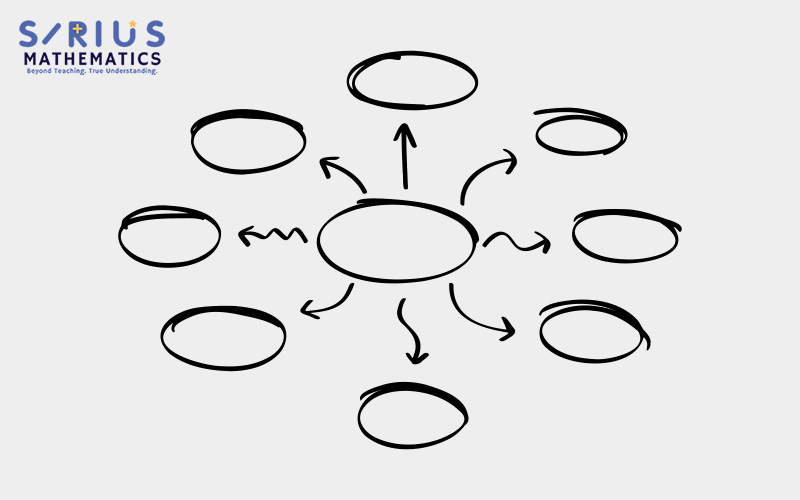
A well-crafted map:- Breaks down complex A-Maths topics into manageable sub-concepts.
- Links formulas to their relevant ideas.
- Acts as a personalised study tool that supports quick and efficient revision.
Introduction
Additional Mathematics topics are often deeply interconnected. Functions that link to graphs, algebra leads to calculus, and trigonometry connects with coordinate geometry. Yet, many students approach these areas as separate chunks. This prevents them from seeing the big picture of how concepts build on and reinforce one another.
Without a connected understanding, it is easy to feel overwhelmed by the syllabus. Fortunately, there’s a practical solution: using a concept map. By visually showing topic interconnections, this map allows you to organise information more clearly and recall formulas more quickly.
Let’s explore how pairing a map with guidance from an A-Maths tutor can make your study sessions more productive.
How Concept Maps Help in A-Maths
1. Break Topics into Sub-Concepts
The last thing you want during revision is to feel lost in a sea of information. Instead of dumping everything under one heading, split each major topic into smaller parts. This helps you to focus on one sub-skill at a time, making it easier to spot gaps in your understanding and target your revision more effectively.
For example, under Functions, you could list:
- Domain and range
- Composite functions
- Inverse functions
- Transformations of graphs
2. Link Formulas to Concepts
A common struggle in A-Maths is remembering which formula belongs where. With so many equations across algebra, calculus, trigonometry, and geometry, it’s easy to confuse them or forget their specific applications. For instance, mixing up differentiation rules with integration formulae can lead to a loss of marks. By formula linking on your concept map, you can visually anchor each formula to its related concept.
Examples:
- Under “Differentiation,” include 𝑑𝑦/𝑑𝑥 rules.
- Under “Trigonometry,” map out the sine and cosine rules.
This way, you won’t waste time flipping through your notes trying to recall where a formula came from. Instead, the recap becomes faster and more accurate during problem-solving.
3. Use Colour and Arrows for Clarity
Visual learning thrives on clarity because the brain processes images and colours faster than blocks of text. When studying A-Maths, using visual cues can help you organise and retrieve information more efficiently. Start by assigning colours to different topic clusters: blue for algebra-related topics, green for geometry, and red for calculus. This creates an instant visual code that helps you locate information at a glance. You can also add arrows to indicate topic interconnections, such as “Algebra → Functions → Calculus,” to maintain a clear flow between concepts.
4. Update Your Map as You Learn
Your first map doesn’t have to be perfect because it’s meant to evolve alongside your learning. At the start, you might only have the basic connections between topics. But as you progress in your studies or attend Additional Maths tuition in Singapore, you’ll explore new relationships, shortcuts, and problem-solving strategies worth adding. Update the map regularly to keep it aligned with what you’ve learned. This helps to strengthen your understanding and reinforces knowledge.
5. Use It for Quick Revision
When exams are near, your concept map can serve as an effective revision strategy. Instead of re-reading entire chapters, you can skim through the map to quickly review the overall structure of the syllabus. It works like a visual cheat sheet, giving you a concise snapshot of key topics and their links. Just a single glance can refresh your memory on how concepts and formulae are connected.

How an A-Maths Tutor Can Help
While a concept map is a powerful tool for connecting ideas, enrolling in tuition takes your mapping to the next level. Tutors can reveal hidden topic links, suggest efficient formula groupings, and provide ready-made maps tailored to the Singapore syllabus. Some even encourage you to discuss your map during class for refinement.
If you’re looking for professional guidance, you’ll find that math tuition rates in Singapore vary depending on the tutor’s experience, class size, and teaching method. Some offer one-to-one sessions, while others run small group classes where you can collaborate on concept maps with peers.
Regardless of the structure or approach, the key is to choose a tuition centre like Sirius Mathematics, where students are supported in approaching exams with confidence. At Sirius Mathematics, we believe that learning goes beyond memorising formulae. We encourage our students to construct solutions, think critically, and develop original ideas.
Get in touch and learn how our tutoring can help you excel in A-Maths.